A test report is useful only when its subject and scope match the question being asked. A cover can identify the report, but the result pages and stated conditions determine what was examined. HONGLIANG’s displayed report cover and summary provide a practical example of how a procurement team can read a sample-specific document without treating it as approval for an entire product range.
Identify the document and dates
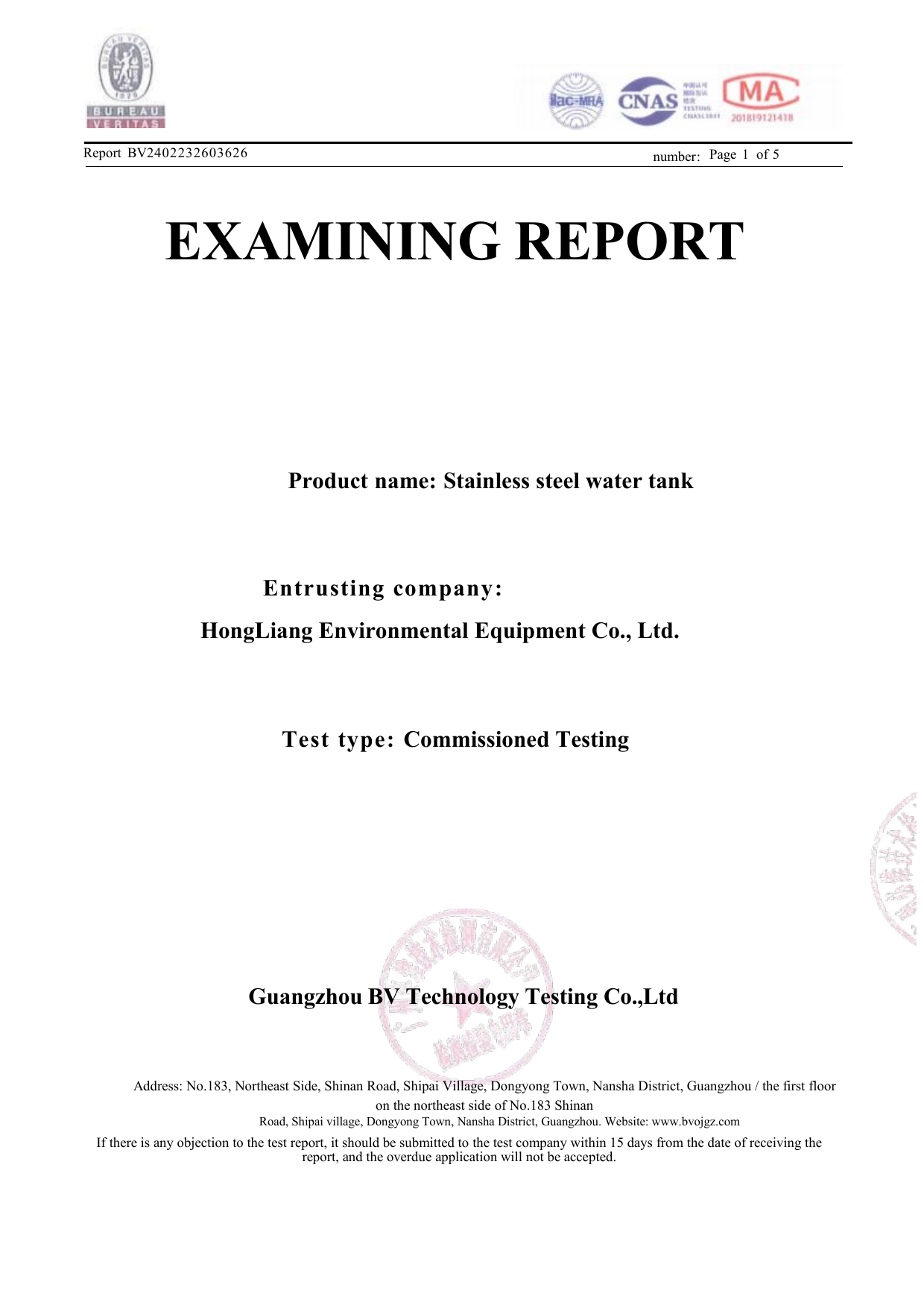
Begin with the report number, laboratory identity, submitted item and the dates attached to the document. The HONGLIANG example is report BV2402232603626. Its examination date is 22 April 2024, while the report was completed and issued on 30 May 2024. Those dates describe different steps; neither should be turned into an expiry date unless the document states one.
The site shows a redacted raster of the original cover. Its QR code is masked, and the complete PDF is not posted. The Quality Documents section gives the sample-limited summary. For a procurement decision, ask for the applicable full report and confirm that it is the version requested for the transaction.
Read the submitted-sample description
The report describes one submitted stainless steel water tank sample as silver metal, stainless steel 304. That description is central to interpretation: it identifies what was submitted for testing. It does not identify every component, every material batch or every future configuration sold under a product name.
Compare the proposed tank’s material and construction documents with the sample description. If the project uses another panel, fitting, seal or assembly, the purchaser should not assume that this sample report covers it. Ask which evidence applies to the actual ordered configuration.
Find the tests and their conditions
The published summary lists sensory assessment and specific migration of lead, chromium, nickel, cadmium and arsenic under the report conditions. A result has meaning within that stated test scope. It should not be paraphrased as a general material, hygiene or whole-tank certification when the report examined a particular submitted sample.
Look for the test method, conditions, units and acceptance index in the full document. If a purchaser needs a different use case or regulatory basis, request documentation matched to that requirement. A catalogue statement or an image of a laboratory cover is not a substitute for checking the relevant pages.
Interpret the stated result narrowly
The report summary states that the submitted sample met the listed index requirements under GB 4806.9-2016 for the tests and conditions reported. This is a finding about that sample, not a statement that all HONGLIANG water tanks are tested, certified or approved for every application. It also does not make the BV report a structural or seismic assessment.
A project may ask for other information such as drawings, material records, inspection records or engineering review. Keep these evidence types separate. Numerical structural analysis, a physical sample test and a third-party certificate answer different questions and cannot be exchanged without checking their scope.
Use the report in a project review
When requesting documents, provide the proposed tank type, material, intended water use and any requirement from the project specification. Ask the supplier to identify the matching report number, sample description, test scope and current document version. Record any difference between the tested sample and the proposed configuration for technical review before relying on the result.
You can read the displayed cover and summary, compare the water tank options, and send your project requirements to discuss documentation for the selected design. The complete report should be reviewed through the appropriate project or procurement channel.
Discuss your water tank requirements
Share intended use, capacity, installation space and requested documents for a project-specific discussion.
Send a project brief